
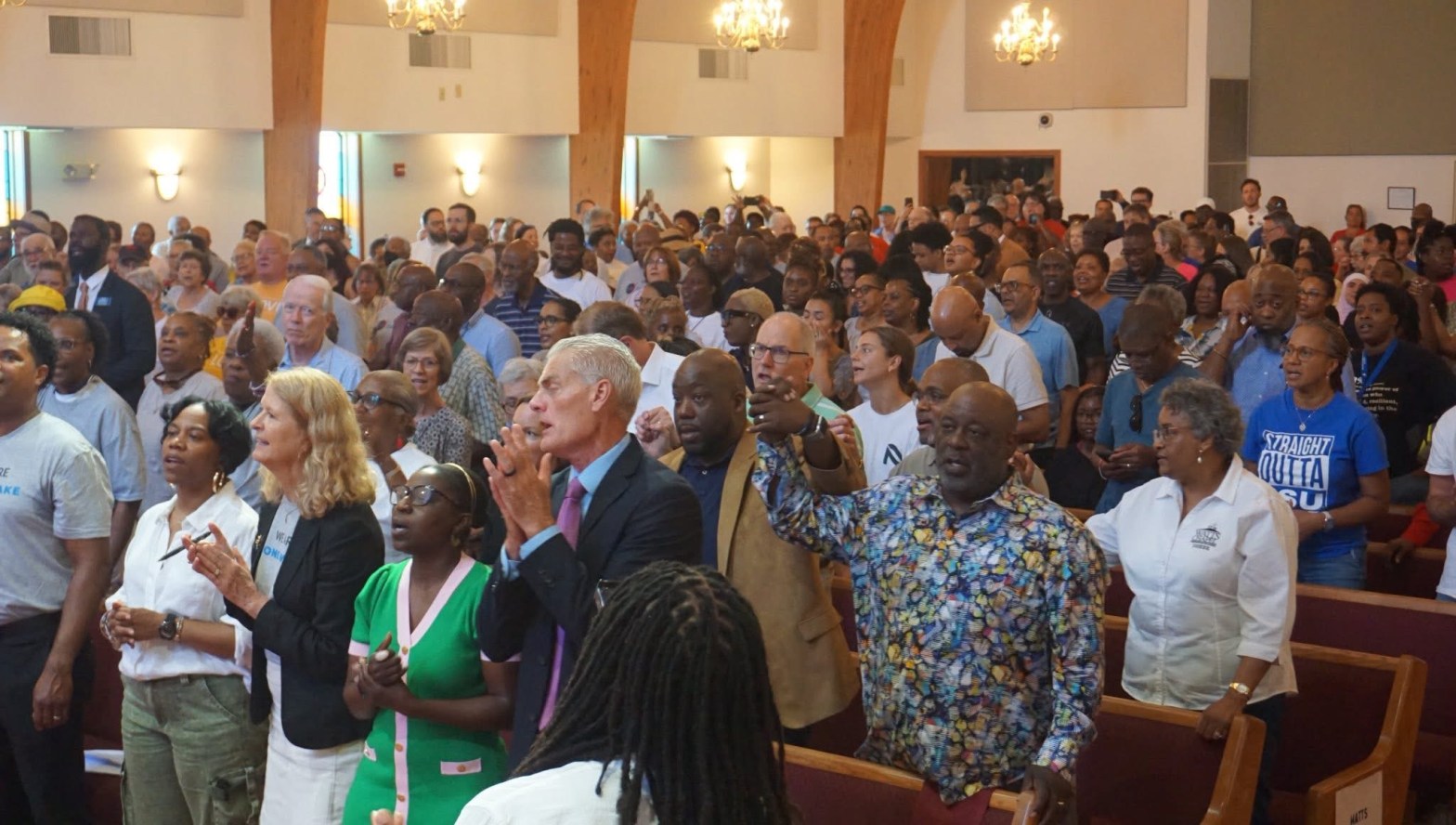
ONE Wake – an assembly of 50 churches across Wake County – held an accountability summit about affordable housing over the weekend. Over 1,000 people showed up to Watts Chapel Missionary Baptist Church, including most of Raleigh City Council. I apologize I could not be there. I see my dad only a few times/year and this was my weekend over the summer to visit him in Ohio.
I wish I could have been at the ONE Wake summit in person, but I provide my thoughts here on their asks and what comes next. Disclosure: I am a member of ONE Wake through my church the Unitarian Universalist Fellowship of Raleigh.
Affordable housing has been one of my three key priorities since I first ran for office in 2022. That hasn’t changed. I applaud ONE Wake for their commitment to ensuring our community has access to safe and stable homes. Below I provide responses to ONE Wake’s questions from the summit. As always, please provide your feedback and ideas for how we can meet our affordable housing goals. Thank you!
Have you increased the affordable housing budget from $30 million last year to $70 million?
No, not yet. It is a real challenge to double budgets in a short time period without significantly raising property taxes. Because property taxes grew so much with the Wake County re-evaluation this past year, we felt it important not to raise taxes for fiscal year 2026. A request from ONE Wake in years past was to implement property tax relief for older, long-time homeowners struggling to stay in their homes. It is a tricky balancing act to keep taxes low and still provide critical services and programs like affordable housing.
Raleigh’s most recent affordable housing bond provided $80 million for projects that started in 2021. It lasts through 2026 and to date 75% of the funds have been committed or spent. Just over $13 million are available on average year to year. Outside of bond funds, the City funds the $8.3 million Housing and Community Development Department which leads our affordable housing initiatives. We also set aside one cent from property tax dollars each year for affordable housing projects. For fiscal year 2026, this generates $11.6 million which is up from $7.8 million two years ago. The City also receives several million dollars in federal entitlement funding annually that supports affordable housing preservation and development. Finally we began a $5 million pilot program to provide rental vouchers to residents experiencing homelessness.
Will you work with ONE Wake to commit 100 acres of the Randleigh tract to be used for 100% affordable homes and apartments?
I am committed to identifying 100 new acres across Raleigh for affordable housing. Because of ONE Wake’s inquiry about the Randleigh tract (305 acres at 3221 Auburn Knightdale Rd), I took this request to City staff and asked for an analysis of the potential for affordable housing here. This land in southeast Raleigh is jointly owned by the City of Raleigh and Wake County. Eventually the 540 highway will run through the property and a fire training center is planned. But 100 acres is available for affordable housing.
I’m posting the staff analysis (see below) about the potential for affordable housing on the Randleigh tract. One major impediment is its distance from amenities and infrastructure like grocery stores, places of work, and bus routes. Affordable housing projects often rely on funding from state and federal sources that prioritize being close to resident needs. But as Raleigh grows, this site will become more connected than ever before.
I am committed to setting aside 100 acres of the Randleigh tract to engage with ONE Wake about next steps for this site. I had a meeting with ONE Wake leaders in June and suggested we meet this fall with City staff and Raleigh City Council members. I will work with ONE Wake to make this happen.
Do you support and will you provide leadership for a new $200 million affordable housing bond referendum?
A new affordable housing bond is of critical importance, and I support it going to voters on the November 2026 ballot. We funded the construction of six new affordable housing projects last year, but we could have funded 12 more with sufficient funds. We are missing opportunities to get new projects on the ground.
Because of recent failed bonds in Wake County (including a $30 million affordable housing bond in Cary), we must choose a number that will be supported by Raleigh residents. ONE Wake’s advocacy is critical for this effort. I will recommend the $200 million bond and work with City staff and community partners like ONE Wake to finalize the figure. I am committed to raising community awareness to ensure success.
Will you work with ONE Wake to maximize affordable units on the old DMV site with a goal of 100% affordable?
The DMV site plans have been led by a community project working group made up of local leaders, legacy residents, and neighborhood advocates in southeast Raleigh. Their two-year community-centered visioning and development process resulted in 55 community engagement events. Top priorities for the DMV site according to the working group are affordable housing; food/market; and community spaces and recreation.
The current plan is for affordable housing to occupy up to two out of the site’s 5.4 acres and produce 110 units at 60% of area median income. The project is designed to be self-financed with market-rate housing to help us preserve citywide affordable housing resources. There will also be space for community-desired resources like a grocery store, community kitchen, or a public library.
Will you commit to meet regularly with ONE Wake and return to another assembly like this to report on progress?
Of course!
AFFORDABLE HOUSING UNDERWAY
Curious how much affordable housing is currently being built with City funding? Over the past 12 months (as of June 30), we have:
- 1,587 City-funded affordable rental units in the predevelopment phase (meaning City Council has approved conditional funding but the project has not started construction),
- 1,478 City-funded affordable rental units under construction, and
- 4,094 City-funded affordable rental units completed.
The majority of affordable housing projects are in District C (southeast Raleigh) and then District D (southwest Raleigh).
| District | Total Development Projects | Competed Projects | Projects Under Construction | Projects in Pre-Construction | Total Units | Completed Units | Units under Construction | Units in Pre-construction |
| A | 5 | 4 | 1 | 0 | 711 | 591 | 120 | 0 |
| B | 9 | 7 | 2 | 0 | 819 | 619 | 200 | 0 |
| C | 37 | 20 | 7 | 10 | 4,102 | 2,258 | 782 | 1,062 |
| D | 18 | 9 | 5 | 4 | 1,313 | 626 | 376 | 373 |
| E | 1 | 0 | 0 | 1 | 152 | 0 | 0 | 152 |
| Total | 70 | 40 | 15 | 15 | 7,159 | 4,094 | 1,478 | 1,587 |
STAFF MEMO on RANDLEIGH TRACT
| To | Evan Raleigh, Assistant City Manager |
| From | Emila Sutton Director, Housing and Community Development Department |
| Date | July 9, 2025 |
| Subject | Affordable Housing Development Feasibility on Randleigh Tract |
Staff has undertaken preliminary site analysis to identify constraints and opportunities for development of this parcel for affordable housing.
Street Address: 3221 AUBURN KNIGHTDALE RD
REID: 0130516
Total acres: 304.87
Prior City Evaluation of Site and Current Status
- Purchased from NCSU 2005
- Master Planning for the tract by City to evaluate broadest public good was put on hold shortly after purchase to plan for the Fire Training Center planned for approximately 71 acres, and then pending I-540 design.
- The COR owns the site jointly with Wake Co. It is expected that after the NCDOT taking and sharing those proceeds with the County, the City will dissolve the joint ownership and settle up with acreage and value among the joint owners. There will likely be a payment required by the City to dissolve the joint ownership agreement. In other words, the site might not actually be free and clear for development without some accounting and costs associated with it.
Zoning
- R-4 (Appx 240 acres)
- Conservation Management (Appx 60 acres along the Neuse River to the north and along the Neuse River Trail to the east of I-540)
- Future Land Use Map
- Approximately 7 acres moderate scale residential
- Appx 20 acres public facilities
- Appx 12 acres commercial mixed used
- Remaining acreage public parks and open space

Constraints
- There are plans for a Fire Training Center on approximately 71 acres in the southwest section of the site. The FTC will ultimately have a Fire Academy that will serve as the training program for fire departments regionally. Plans include a driving pad (phase 1) for training in the operation of large fire trucks including engines and ladder trucks under real life conditions. It will also have a fire tower that will have the means to accommodate real blaze situations for trainees to extinguish. Noise, commotion, at least some smoke, and possible smells could be expected from proximity to a facility such as this.
- I-540 will cut through the site. Clearing has started according to NCDOT and is scheduled to be completed in 2028.
- Noise from I-540 will likely be a negative environmental factor making use of federal funding problematic due to environmental review/scan requirements.
- A significant amount of the acreage will be severed by 540 and will only be accessible by a small service road to the east of 540 or through a service culvert connecting under 540 to the western portion of the site.
- Phase I ESA prepared for City of Raleigh Public Utilities in 2005 revealed petroleum constituents at the machine shop and soil and groundwater contamination. The report recommended the on-site water supply well be properly abandoned and recommended a Comprehensive Site Assessment. Limits of contamination were confirmed and contaminated soils removed in 2006. NCSU (previous owner) is managing remediation and monitoring of the site.
- In 2011, perpetual land use restrictions were recorded prohibiting the use of groundwater as a water supply for an area approximately 0.25 acres of the site and NC DENR determined no further action was required.
- There is no nearby transit access. The closest transit stop is 1.8 miles away via Battle Bridge Road which has no sidewalks.
- Current zoning, Future Land Use, and location do not support multi-family rental development
- The site is not feasible as a 9% LIHTC due to distance from required amenities. Required grocery store amenity is 1.8 miles from site. It could be feasible as a 4% but market study may not support.
Opportunities
- Within 10-minute drive time from 3 fire stations
- Water and sewer exist on the site
- No major floodplain or topography issues
- Current zoning allows single unit living or 2-unit living
- Due to unit size and type and therefore cost, an affordable homeownership model is likely more feasible than affordable rental under current zoning.
Nearby Uses
- Raleigh Water wastewater treatment plant directly east of this parcel. Much of the acreage around that facility is utilized to spray / spread biosolids as a means of allowing it to leach back into the soil.
- Wake County Law Enforcement Training Center is on the opposite site of 540 from the FTC. It also has a police force driving pad and an indoor firing range.
- Wake County may be pursuing plans for a large new animal shelter and animal control facility at the SE corner of Auburn Knightdale and Battle Bridge, just opposite the FTC.
- A new Raleigh Police Evidence complex is in design for a site on Battle Bridge just east of the new 540-corridor. Construction will be completed by the end of 2027.
Disposition Methods
- It has been our standard operating procedure over the last few years is to strictly lease city-owned land for affordable housing development thereby maintaining affordability in perpetuity.
- This ground lease model is consistent with an affordable homeownership model, and the control of the land is through a lease from the City to a condominium association.
- That association could be a single purpose entity managed by a non-profit entity qualifying it for a nominal lease payment for the duration of the long-term ground lease.
- Further affordability of ownership would be enhanced by the preservation of the tax exemption for the land as the COR would still maintain ownership.
- A 99-year ground lease would allow for the properties to be sold and financed multiple times, and a new ground lease could be done in year 70 that could allow for the sales to be financed even late in the initial term.
- Because the ground lease is nominal and prepaid, it could easily be subordinate to the primary financing for the individual units.
- Additional terms might be included to perpetuate affordability such as deed restrictions that cap the resale of the units to a percentage of appraised value to pass along both affordability and some of the natural appreciation to the original owners.
 janeforraleigh.com
One thought on “Committed to Affordable Housing”